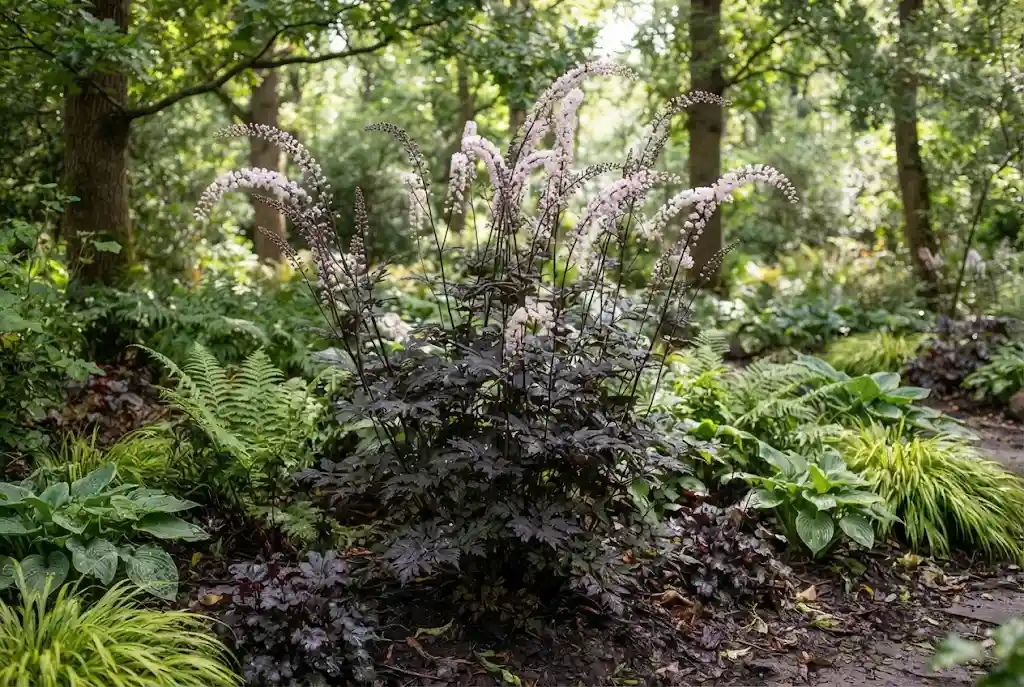
Its combination of dramatic foliage and late-season flowers makes it particularly useful in woodland gardens, shaded borders, and mixed perennial plantings. With the right moisture and light conditions, it can become a strong focal point without demanding complicated routine care.
What Is Cimicifuga Hillside Black Beauty?
Cimicifuga ‘Hillside Black Beauty’ belongs to the Actaea group of herbaceous perennial plants in the buttercup family, Ranunculaceae. It is also commonly called bugbane or baneberry.
The cultivar is best known for its finely divided, dark purple to almost-black foliage. Above the foliage, tall flower stems rise in late summer and early fall, producing slender clusters of small, fragrant flowers.
The exact flower color can be described slightly differently depending on the growing reference, ranging from pale pink to creamy white. The contrast between the dark foliage and lighter flower spikes is one of the plant’s defining landscape features.
Why Hillside Black Beauty Stands Out
Many shade-loving perennials are valued primarily for their flowers or foliage. Hillside Black Beauty combines both features in a particularly dramatic way.
Its dark foliage creates depth in a planting scheme, especially when positioned beside plants with green, silver, golden, or lighter-colored leaves. Later in the growing season, the tall flower spikes add height above the foliage and introduce a lighter visual element.
The plant can reach roughly 4 to 6 feet in height under suitable conditions, with some horticultural references giving an even broader mature range. The foliage forms a lower clump while the flower stems provide much of the plant’s eventual height.
Where Should You Plant Hillside Black Beauty?
The best location is generally one with partial shade to full shade and consistently moist soil. The Royal Horticultural Society recommends partial shade, while the Missouri Botanical Garden lists part shade to full shade as suitable conditions.
A sheltered position is particularly helpful because tall flower stems can be affected by strong winds. In very deep shade, the flower spikes may also lean toward available light.
Good garden locations include:
- Woodland-style gardens
- Shaded perennial borders
- Areas beneath trees where soil remains moist
- Informal cottage gardens
- Naturalized planting areas
- Shaded garden corners that need vertical interest
It can also work as a specimen plant, although groups of plants can create a stronger visual effect once they become established.
How Much Sun Does Cimicifuga Hillside Black Beauty Need?
Hillside Black Beauty generally performs best in partial shade to full shade. The dark foliage can be vulnerable to scorching when exposed to excessive direct sun, particularly when moisture levels are inadequate.
Some growing references note that the plant can tolerate more sunlight in cooler climates, but a protected position with afternoon shade is generally a safer choice where summers are hot.
If you notice browning leaf edges, fading foliage, or general stress during hot weather, excessive sun exposure combined with insufficient moisture may be contributing factors.
Soil Requirements
Moisture is one of the most important considerations when growing Hillside Black Beauty.
The plant prefers fertile soil with plenty of organic matter and enough moisture to prevent the root zone from drying out. The Missouri Botanical Garden recommends humus-rich, moisture-retentive soil, while the RHS lists clay and loam soils among suitable soil types.
Good drainage still matters. Moist soil does not mean permanently waterlogged soil. Improving heavy soil with organic matter can help create a better balance between moisture retention and drainage.
Ideal soil conditions include:
- Moist but not stagnant
- Rich in organic matter
- Reasonably fertile
- Well drained while retaining moisture
- Protected from prolonged drying
How to Plant Hillside Black Beauty
Choose the planting position carefully before putting the plant in the ground. Because Hillside Black Beauty prefers consistent moisture and shade, a location with naturally suitable conditions can reduce maintenance later.
Step 1: Prepare the planting site
Remove weeds and loosen the soil around the planting area. Incorporate organic matter if the soil is poor or lacks structure.
Step 2: Position the plant
Place the plant so that the crown sits at approximately the appropriate soil level rather than being buried deeply. Follow the nursery’s planting instructions if they provide specific guidance for the container-grown plant.
Step 3: Water thoroughly
Water deeply after planting to settle the soil around the roots. Keep the soil consistently moist while the plant becomes established.
Step 4: Add mulch
A layer of organic mulch can help conserve soil moisture and moderate temperature around the root zone. Keep mulch slightly away from the crown rather than piling it directly against the plant.
Watering Hillside Black Beauty
Consistent moisture is one of the most important parts of caring for this perennial.
Established plants may tolerate occasional short periods of dryness better than newly planted specimens, but the foliage generally looks best when the soil does not repeatedly dry out. The Missouri Botanical Garden specifically notes that foliage can scorch and deteriorate when soil is allowed to become dry.
During extended hot or dry periods, check the soil around the plant rather than relying only on a fixed watering schedule. Water deeply when necessary and avoid creating persistently saturated conditions.
When Does Hillside Black Beauty Bloom?
Hillside Black Beauty is valued for its late-season flowering. Depending on climate and growing conditions, flower spikes generally appear from late summer into early fall.
The flowers are small individually but are arranged along tall, narrow stems, creating a distinctive bottlebrush or wand-like appearance. Their fragrance adds another layer of interest when the plant is in bloom.
The late flowering period can also help extend seasonal interest after many summer perennials have already finished blooming.
Hillside Black Beauty as a Shade Garden Focal Point
The dark foliage makes this cultivar especially effective when used as a visual anchor in a shade garden.
Plants with bright green, silver, gold, or variegated foliage can create strong contrast against its purple-black leaves. Ferns and hostas are natural companions for this type of planting because their foliage textures can complement the finely divided leaves.
When the flower spikes emerge, they rise above the surrounding foliage and provide additional height and movement.
Best Companion Plants
Choose companion plants with similar moisture and shade requirements rather than selecting plants solely for appearance.
Hostas
Hostas provide broad leaves that contrast nicely with the fine texture of Hillside Black Beauty’s foliage.
Ferns
Ferns reinforce the woodland character of the planting and offer another delicate foliage texture.
Astilbes
Astilbes can provide contrasting foliage and flowering structure in moist, shaded garden conditions.
Bleeding Hearts
Bleeding hearts can complement the informal woodland character of the plant while adding a different foliage and flower form.
Toad Lilies
Toad lilies can extend the late-season interest of a shade garden and work well in planting schemes built around moisture-loving perennials.
How Fast Does Hillside Black Beauty Grow?
This is not a perennial to choose when you need an instant mature specimen. Several horticultural sources describe Hillside Black Beauty as slow to establish.
Once established, however, it can develop into a substantial clump with tall flowering stems. Giving the plant suitable moisture, organic-rich soil, and protection from excessive sun can help it settle into its growing position.
Patience is therefore part of the appeal. A young plant may look modest compared with its eventual mature form.
Common Problems to Watch For
Hillside Black Beauty is generally considered relatively low maintenance, but unsuitable growing conditions can create problems.
Leaf scorch
Brown leaf margins or deteriorating foliage can occur when the plant experiences excessive heat, direct sun, or insufficient moisture.
Leaf spot and rust
Horticultural references identify leaf spot and rust as occasional disease problems. Good growing conditions and appropriate garden hygiene can help reduce stress on the plant.
Flower stems leaning
Tall flower stems may lean toward brighter light, particularly in deep shade. Strong winds can also cause problems, so a sheltered planting position is useful.
Poor growth after planting
Hillside Black Beauty can take time to establish. Poor moisture conditions, excessive sunlight, or unsuitable soil can make establishment slower.
Is Hillside Black Beauty Deer Resistant?
Several horticultural references describe this cultivar as deer resistant or deer tolerant. That can make it useful in gardens where browsing pressure is a concern.
However, no plant should be treated as completely immune to animal damage. Deer behavior varies by location and available food, so local conditions still matter.
Does Hillside Black Beauty Attract Pollinators?
The fragrant late-season flowers can provide value to pollinators. The Morton Arboretum notes that bugbane attracts birds and butterflies, while Walters Gardens lists the cultivar as butterfly and bee friendly.
This makes Hillside Black Beauty useful not only for foliage contrast and seasonal interest but also as part of a broader wildlife-friendly planting scheme.
How to Maintain Hillside Black Beauty
Routine maintenance is relatively straightforward once the plant is established.
- Keep the soil consistently moist.
- Apply organic mulch to help retain moisture.
- Protect the plant from excessive afternoon sun in hot climates.
- Remove damaged or diseased foliage when appropriate.
- Provide support if tall flower stems become unstable.
- Cut the plant back after flowering or fruiting according to your garden’s needs.
Because the plant is slow to establish, avoid repeatedly moving it unless its growing conditions are clearly unsuitable.
Why Add Hillside Black Beauty to Your Garden?
The strongest reason to grow Hillside Black Beauty is its combination of unusual foliage and late-season flowers.
Its dark leaves can solve a common shade-garden design problem: adding strong color and structure without relying on bright flowers. When the pale flower spikes appear, they provide a second layer of contrast and vertical interest.
It is also a useful option for gardeners who want a perennial that returns year after year and can become an established part of a woodland or shaded border.
Frequently Asked Questions
Is Cimicifuga Hillside Black Beauty the same as Actaea Hillside Black Beauty?
Yes. Actaea simplex ‘Hillside Black Beauty’ is the current botanical name used by horticultural references, while Cimicifuga is a former or synonymous name still commonly associated with the plant.
Does Hillside Black Beauty prefer sun or shade?
It generally prefers partial shade to full shade. In hot climates, protection from strong afternoon sun is particularly important for maintaining healthy foliage.
How tall does Hillside Black Beauty get?
Depending on conditions and the reference used, mature plants can reach approximately 4 to 6 feet, with some horticultural sources reporting a wider range.
How often should Hillside Black Beauty be watered?
It prefers consistently moist soil. Water when the soil begins to dry and provide deeper watering during prolonged dry periods, while avoiding permanently waterlogged conditions.
When does Hillside Black Beauty flower?
It generally flowers in late summer or early fall, producing tall spikes of small, fragrant, pale-colored flowers.
Is Hillside Black Beauty easy to grow?
It is relatively low maintenance once established, but it can be slow to establish and performs best when moisture, shade, and soil conditions are suitable.
Final Thoughts
Cimicifuga ‘Hillside Black Beauty’ offers something different from many traditional garden perennials. Its purple-black foliage brings dramatic color and texture to shaded spaces, while its tall, fragrant flower spikes add height and late-season interest.
The key to growing it successfully is choosing the right location. Give it partial to full shade, fertile organic-rich soil, and consistent moisture, and allow it time to establish.
For woodland gardens, shaded borders, and other areas where bold foliage is needed, Hillside Black Beauty can become a distinctive and long-lasting part of the landscape.