What Makes an Engineering Marvel?
An engineering marvel does not have to be the tallest, longest, or largest structure in the world. Its significance can come from solving a difficult technical problem, introducing an innovative structural system, working within unusual environmental conditions, or combining performance with distinctive design.
The Institution of Civil Engineers’ engineering wonders overview highlights structures ranging from the International Space Station to the Golden Gate Bridge, illustrating how different engineering disciplines can produce extraordinary results.
Several characteristics commonly appear in major engineering achievements:
- Innovative structural or mechanical design
- Careful selection and use of materials
- Solutions to difficult environmental conditions
- Advanced modeling, testing, or construction methods
- Strong integration between function and visual form
- Long-term performance and maintainability
Where Art and Engineering Meet
Architecture and engineering are not identical disciplines, but major projects often depend on close cooperation between them.
An architect may establish the visual concept, spatial experience, and relationship with the surrounding environment, while engineers determine how that concept can safely and efficiently become a physical structure.
The most successful projects do not necessarily make those two objectives compete. Instead, structural requirements can become part of the visual language.
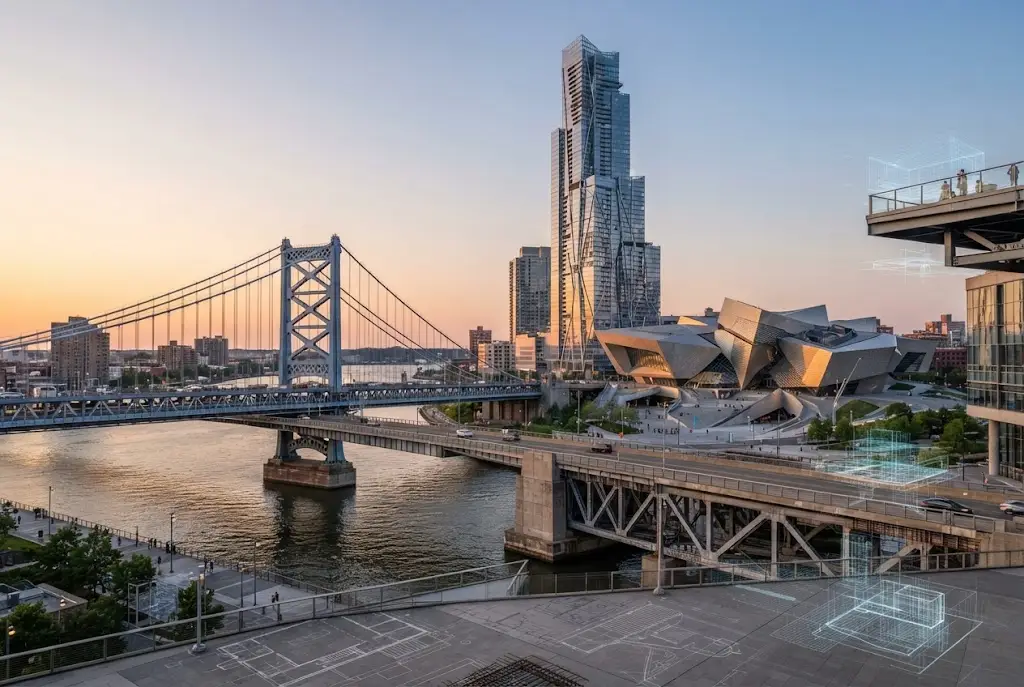
A suspension bridge, for example, exposes cables and towers that are essential to its structural behavior. A skyscraper may use its structural core or exterior framing as an important part of its appearance. A large cultural building may turn an unusual structural system into its defining architectural feature.
The Eiffel Tower: When Structure Becomes Architecture
The Eiffel Tower is one of the clearest examples of structural engineering becoming an architectural identity.
Its open iron lattice is visually distinctive, but the arrangement of the structure also reflects the need to manage loads and wind effects efficiently. Instead of hiding the structural framework behind a solid exterior, the tower makes the framework itself the visual centerpiece.
That approach helped establish an enduring connection between structural logic and architectural expression. The result is a landmark recognized not only for what it represents but also for how its engineering is visible in its form.
The Golden Gate Bridge: Engineering Across a Difficult Span
The Golden Gate Bridge demonstrates another important principle: engineering responds to a specific site.
The bridge crosses the Golden Gate, where engineers had to account for a large span, strong winds, deep water, and the practical requirements of connecting San Francisco with Marin County.
Its suspension system distributes the loads through the main cables, suspenders, towers, and anchorages. The result is a structure whose visual elegance is closely connected to its structural function.
The bridge is also an example of how infrastructure can become part of the identity of a city. Its engineering purpose remains essential, but its silhouette has become equally recognizable.
The Burj Khalifa: Engineering for Extreme Height
Super-tall buildings create a different set of engineering challenges. As a structure becomes taller, gravity is only part of the problem. Wind forces and building movement become increasingly important to the design.
The Burj Khalifa in Dubai illustrates how structural geometry can help address these challenges. Its stepped, tapering form reduces the uniformity that would otherwise allow wind effects to build in predictable patterns.
Its design combines architecture, structural engineering, materials science, mechanical systems, and construction technology. The building’s appearance is therefore closely connected to the engineering decisions required to make extreme height practical.
Modern supertall design continues to rely on computational analysis, physical testing, and increasingly sophisticated structural modeling to understand how buildings behave under different loads.
Sydney Opera House: Engineering an Unusual Form
The Sydney Opera House shows what happens when an ambitious architectural concept demands an equally ambitious engineering solution.
Its distinctive roof shells give the building an appearance unlike conventional rectangular performance halls. Creating those curved forms required engineers and architects to develop ways of translating complex geometry into a buildable structure.
The project demonstrates an important lesson in engineering design: unusual shapes often require new ways of thinking about geometry, construction, materials, and repetition.
The Institution of Structural Engineers includes the Sydney Opera House among its collection of iconic structures, alongside buildings and bridges that demonstrate very different structural approaches.
Millau Viaduct: Making Infrastructure Visually Light
Bridges can be massive pieces of infrastructure, yet some successful designs create a visual impression of lightness.
The Millau Viaduct in France is a cable-stayed bridge whose slender profile and tall piers allow it to cross a deep valley while minimizing the visual heaviness associated with large infrastructure.
The engineering challenge involved coordinating the deck, cables, piers, foundations, wind conditions, construction sequence, and surrounding terrain.
Its appearance demonstrates that infrastructure does not have to be visually separate from the landscape. Engineering can be used to create a structure that responds to its environment rather than simply dominating it.
The International Space Station: Engineering Beyond Earth
Engineering marvels are not limited to structures fixed to the ground.
The International Space Station represents an entirely different engineering environment. Its components have been assembled in orbit, where designers must account for microgravity, radiation, extreme temperature changes, limited resources, and the demands of long-term human habitation.
The station is also an example of international engineering collaboration. Its development and assembly involved multiple national space agencies and a long sequence of missions.
Its beauty is less about conventional architecture and more about the remarkable complexity of creating a functioning human environment beyond Earth.
The Materials Behind Engineering Beauty
Materials have a major influence on both performance and appearance.
Steel
Steel combines strength, flexibility, and relatively efficient structural performance, making it important in bridges, towers, stadiums, and other large structures.
Concrete
Concrete is widely used because it can carry substantial compressive loads and can be shaped into many forms. Reinforced concrete combines concrete with steel reinforcement to handle different types of structural forces.
Glass
Glass can provide transparency, daylight, and visual openness. In modern architecture, engineers must also consider thermal performance, wind pressure, solar exposure, and the behavior of large glazed surfaces.
Composite materials
Modern engineering increasingly combines digital technology with sustainable design. You can also explore our article on sustainable digital product engineering for a related perspective.
Why Geometry Matters in Engineering
Geometry is one of the strongest links between engineering and visual design.
Curves, arches, triangles, trusses, shells, grids, and tapered forms can distribute forces in different ways. Engineers can therefore use geometry not simply to create visual interest but to influence how a structure carries loads.
This is why many iconic structures look the way they do for a reason. Their shapes may be influenced by gravity, wind, span requirements, material limitations, construction methods, or the need to reduce movement.
Good engineering can make a technical solution appear almost effortless because the final form hides the complexity of the calculations and testing behind it.
The Role of Technology in Modern Engineering
Digital technology has changed how engineers design, test, and construct complex structures.
Computer-aided design allows teams to develop detailed digital models. Structural analysis software can simulate how a design responds to different loads and conditions. Building information modeling can help coordinate different systems before construction begins.
Computational methods also make it easier to investigate complex geometries that would have been difficult to analyze manually.
These tools do not replace engineering judgment. Instead, they give engineers better ways to test ideas, identify potential problems, coordinate disciplines, and refine designs before materials are permanently assembled.
How Engineering Responds to Nature
Nature is one of the biggest constraints engineers must understand.
Wind affects tall buildings and bridges. Water affects dams, tunnels, foundations, and coastal structures. Earthquakes influence structural systems in seismic regions. Temperature changes can cause materials to expand and contract.
Engineering design therefore begins with understanding the environment in which a structure must operate.
A visually impressive building that cannot withstand its expected conditions is not an engineering success. The real achievement is creating a structure that performs reliably while meeting architectural and practical objectives.
Sustainability Is Becoming Part of Engineering Design
Modern engineering is increasingly concerned with the environmental consequences of construction and operation.
A structure’s environmental impact can involve material extraction, transportation, construction, energy use, maintenance, demolition, and eventual reuse or recycling.
Engineers can address these issues through strategies such as efficient structural systems, lower-impact materials, adaptive reuse, energy-efficient building systems, passive design, and longer-lasting components.
Sustainability therefore adds another dimension to the relationship between beauty and engineering. A successful structure should not only look impressive at completion; its long-term environmental performance also matters.
Engineering Beauty in Everyday Infrastructure
Engineering marvels are not limited to famous landmarks.
Everyday infrastructure contains examples of careful engineering that most people rarely notice. Bridges, transit stations, water systems, tunnels, power networks, roads, airports, and pedestrian infrastructure all depend on engineering decisions.
Some projects become famous because their design is visually distinctive. Others are successful precisely because their engineering works quietly in the background.
This broader perspective changes how we think about engineering beauty. It can be found in an elegant bridge connection, an efficient transit station, a well-designed public space, or a structural system that solves a difficult problem without unnecessary complexity.
The Connection Between Engineering and Urban Life
Large engineering projects can influence the way cities function.
A bridge can reduce travel barriers. A transit system can connect neighborhoods. A well-designed public building can become a cultural landmark. Infrastructure can also influence how people interact with streets, parks, waterfronts, and public spaces.
Engineering therefore contributes to the visual identity of cities as well as their practical operation.
The relationship is particularly visible when infrastructure becomes a recognizable landmark. The structure starts as a technical solution but eventually becomes part of the cultural image of the place around it.
Engineering Challenges Behind Beautiful Structures
The finished appearance of an engineering marvel can make the construction process look simpler than it actually was.
Engineers may have to balance competing requirements involving:
- Structural safety
- Construction cost
- Material availability
- Environmental conditions
- Energy performance
- Maintenance requirements
- Construction time
- Regulatory requirements
- Long-term durability
- Architectural goals
Improving one characteristic can sometimes make another more difficult. A lighter structure may require different materials. A more complex shape may increase construction difficulty. Greater glazing may improve visual openness while creating additional thermal considerations.
Engineering is therefore largely an exercise in finding workable balances.
What the Future of Engineering Marvels Could Look Like
Future engineering projects are likely to combine physical innovation with increasingly powerful digital tools.
Advanced computational design, robotics, additive manufacturing, modular construction, artificial intelligence, sensors, and digital twins could change how complex structures are designed and maintained.
Artificial intelligence may assist engineers with tasks such as analyzing large datasets, exploring design alternatives, identifying patterns, and optimizing certain systems. Human engineers will still need to define requirements, evaluate trade-offs, verify results, and make decisions where safety and uncertainty are involved.
At the same time, engineering is likely to place greater emphasis on resilience and sustainability. Future landmarks may be judged not only by their appearance but also by how efficiently they use resources and how well they adapt to changing environmental conditions.
Why Engineering Marvels Matter
Engineering marvels matter because they demonstrate what happens when technical knowledge is combined with imagination.
A bridge can become a symbol of a city. A tower can change a skyline. A cultural building can become an architectural landmark. A space station can expand the boundaries of human habitation.
These projects remind us that engineering is not simply about making things stand up or work correctly. At its best, engineering transforms constraints into opportunities for new forms, new systems, and new ways of using the built environment.
Frequently Asked Questions
What is an engineering marvel?
An engineering marvel is a structure, system, or project recognized for solving significant technical challenges through innovative design, materials, construction methods, or engineering principles.
What are some famous engineering marvels?
Examples include the Eiffel Tower, Golden Gate Bridge, Burj Khalifa, Sydney Opera House, Millau Viaduct, Hoover Dam, Panama Canal, and International Space Station. Each represents different engineering disciplines and challenges.
How are engineering and architecture connected?
Architecture focuses heavily on form, space, experience, and the relationship between a building and its surroundings, while engineering addresses structural behavior, materials, systems, safety, and performance. Major projects require these disciplines to work together.
Why are materials important in engineering design?
Materials determine many aspects of a structure’s strength, weight, durability, appearance, cost, and environmental performance. Engineers select materials according to the demands of the project rather than aesthetics alone.
How is technology changing engineering?
Digital modeling, simulation, computational design, robotics, sensors, and artificial intelligence are giving engineers more sophisticated ways to analyze, optimize, coordinate, and monitor complex projects.
Can engineering structures also be works of art?
Yes. When structural requirements, architectural design, materials, and construction methods are integrated successfully, the resulting structure can have both practical value and strong visual or cultural significance.
Final Thoughts
The most fascinating engineering marvels demonstrate that technical precision and visual creativity do not have to exist separately. A bridge can be structurally efficient and visually elegant. A skyscraper can respond to wind while creating a distinctive skyline. A cultural building can turn complex geometry into an expressive architectural form.
Engineering beauty ultimately comes from solving difficult problems in thoughtful ways. The structures that remain memorable are often those where science, materials, technology, architecture, and human creativity reinforce one another.
As engineering continues to evolve, the next generation of marvels will likely be judged by more than size or appearance. The strongest projects will combine innovation, resilience, efficiency, sustainability, and design to create structures that work beautifully and look the part.