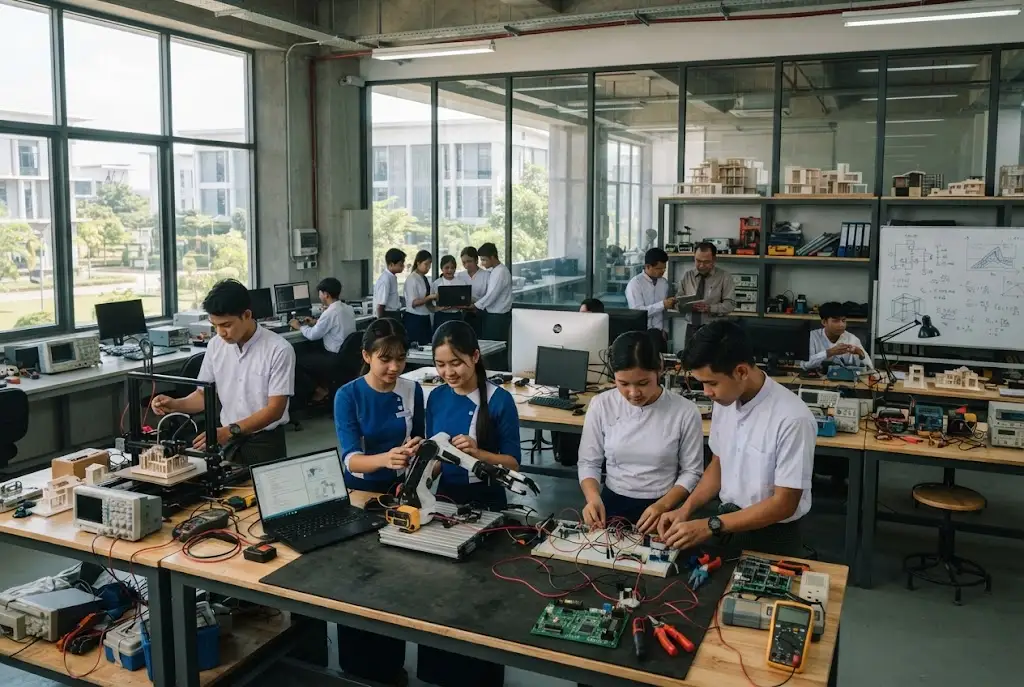
For students interested in engineering, technology, architecture, and applied problem-solving, choosing the right university is an important decision. Technological University Hmawbi, also known as TU Hmawbi, is an engineering-focused university in Hmawbi, Yangon Region, Myanmar.
The institution has developed from a technical education center into a university offering undergraduate and postgraduate programs across engineering and architecture. Its current academic portfolio covers civil engineering, mechanical engineering, electronic engineering, electrical power engineering, mechatronic engineering, information technology, and architecture.
Beyond degree programs, TU Hmawbi emphasizes engineering education, research and development, innovation, professional ethics, problem-solving, collaboration, and connections with other institutions. This makes it a useful institution to examine for students who want a technology-oriented higher education pathway.
What Is Technological University Hmawbi?
Technological University Hmawbi is a technology and engineering-focused higher education institution located in Hmawbi, Yangon Region, Myanmar.
According to the university’s official history, the institution began as a Technical High School in 1989. It was subsequently upgraded to a Government Technical Institute in 1998 and a Government Technological College in 2001. On January 20, 2007, it became Technological University.
The university states that it has been under the Ministry of Education since April 2016. Its academic development has centered on producing engineers and architects who can apply scientific and technical knowledge to real-world problems.
The university’s stated vision is to become an internationally recognized institution that develops highly qualified engineers and architects for Myanmar’s development.
A Look at the History of TU Hmawbi
The development of Technological University Hmawbi reflects the gradual expansion of technical education in the Hmawbi area.
Technical High School
The institution began as a Technical High School in October 1989. At this stage, its role was centered on technical education rather than university-level engineering degrees.
Government Technical Institute
In 1998, the institution was upgraded to Government Technical Institute status. The university’s historical account says this stage was intended to support the development of technicians.
Government Technological College
In January 2001, the institution became a Government Technological College. This represented another step toward providing higher-level technological and engineering education.
Technological University
On January 20, 2007, the institution was upgraded to Technological University status. Its development subsequently expanded into multiple engineering disciplines and architecture.
This history is useful for understanding why TU Hmawbi has such a strong emphasis on applied engineering and technical education rather than functioning as a broad liberal-arts university.
Programs Offered at Technological University Hmawbi
The university’s current official program page lists seven undergraduate programs and seven postgraduate programs. The undergraduate portfolio includes six engineering disciplines plus architecture.
Bachelor’s Degree Programs
- B.E. in Civil Engineering
- B.E. in Mechanical Engineering
- B.E. in Electronic Engineering
- B.E. in Electrical Power Engineering
- B.E. in Mechatronic Engineering
- B.E. in Information Technology
- B.Arch. in Architecture
This range gives students several pathways into traditional engineering as well as technology-oriented disciplines such as information technology and mechatronics.
Postgraduate Programs
The university also lists postgraduate programs in the same major technical areas:
- M.E. in Civil Engineering
- M.E. in Mechanical Engineering
- M.E. in Electronic Engineering
- M.E. in Electrical Power Engineering
- M.E. in Mechatronic Engineering
- M.E. in Information Technology
- M.Arch. in Architecture
Students considering postgraduate study should confirm current admission requirements, schedules, fees, and program availability directly with the university because these details can change between academic years.
Engineering Disciplines at TU Hmawbi
Civil Engineering
Civil engineering focuses on the design, construction, and management of infrastructure. At TU Hmawbi, the Civil Engineering department covers areas including structural engineering, geotechnical engineering, water resources, environmental engineering, construction engineering management, and transportation engineering.
The department also describes laboratory facilities supporting areas such as building materials, environmental engineering, geotechnical engineering, fluids, hydraulics, and workshops.
Mechanical Engineering
Mechanical engineering provides a foundation for designing, analyzing, and developing mechanical systems. It can lead toward professional areas involving manufacturing, machinery, thermal systems, energy, maintenance, and industrial engineering applications.
Electronic Engineering
Electronic engineering connects electrical systems with digital technologies and communications. TU Hmawbi’s Electronic Engineering department identifies areas such as microelectronics, digital electronics, telecommunications, control engineering, RF and microwave engineering, signal processing, and microprocessors and microcontrollers.
This makes the discipline particularly relevant to students interested in electronics, communications, embedded systems, and related technologies.
Electrical Power Engineering
Electrical Power Engineering focuses on electrical energy systems and the technologies involved in generating, transmitting, distributing, and managing electrical power.
The discipline can provide a foundation for work connected with electrical infrastructure, power systems, industrial electrical applications, and energy-related engineering.
Mechatronic Engineering
Mechatronics combines elements of mechanical engineering, electronics, control systems, and computing. It is especially relevant to modern automation and intelligent-machine applications.
For students interested in robotics, automated systems, sensors, control technologies, and interdisciplinary engineering, mechatronics provides a pathway that connects several technical fields.
Information Technology
The Information Technology program provides a technology-focused route for students interested in computing and digital systems.
As organizations increasingly depend on software, networks, databases, cybersecurity, cloud infrastructure, and digital services, IT education can provide a foundation for a wide range of technology careers.
Architecture
Architecture is also part of TU Hmawbi’s current undergraduate and postgraduate academic portfolio. The discipline combines design, planning, building technology, structural considerations, and the practical requirements of the built environment.
Research, Innovation, and Practical Engineering
The phrase “cutting-edge innovation” in the original article should not be interpreted as a claim that every program or facility is at the technological frontier. A more accurate description is that innovation is part of the university’s stated educational philosophy and mission.
TU Hmawbi says it aims to develop graduates who can apply engineering and architectural knowledge to real-world environments while developing complex problem-solving, critical-thinking, innovation, teamwork, and professional ethics.
The university also says it maintains links with other technological universities in Myanmar and has signed memoranda of understanding with universities in the ASEAN region. It describes curriculum benchmarking with other universities as part of its effort to support educational quality and international standards.
For students, this matters because engineering education is most useful when theoretical knowledge can be connected with practical problem-solving and professional requirements.
Quality Assurance and Engineering Accreditation
Quality assurance is an important consideration when evaluating an engineering institution.
The university states that it received ISO 9001:2008 certification for its quality management system in 2015 and was upgraded to ISO 9001:2015 in 2018.
The Engineering Education Accreditation Committee’s current published list also identifies TU Hmawbi engineering programs. The list shows six Bachelor of Engineering programs—Civil, Electrical Power, Electronics, Information Technology, Mechanical, and Mechatronics—with accreditation periods extending from the 2024–2025 academic year through 2026–2027.
Students should still verify the exact accreditation status of the specific program and intake they intend to join before making an enrollment decision.
Academic Departments and Supporting Subjects
Engineering education requires more than specialist courses. Students also need mathematical, scientific, communication, and foundational knowledge.
TU Hmawbi’s department structure includes engineering departments alongside supporting departments for Myanmar, English, Engineering Mathematics, Engineering Physics, and Engineering Chemistry.
This structure reflects the interdisciplinary nature of engineering education. Mathematics and physical sciences provide the foundations for technical analysis, while communication and language skills help students document, present, and collaborate on professional work.
Why Engineering Students May Consider TU Hmawbi
There are several practical reasons a student may consider Technological University Hmawbi.
Multiple Engineering Pathways
The university offers several major engineering disciplines rather than concentrating on a single specialization. Students can choose between civil, mechanical, electronic, electrical power, mechatronic, and IT-focused education.
Architecture Is Included
Students interested in the built environment have an additional pathway through architecture, including both bachelor’s and master’s study.
Applied Technical Focus
The institution’s history and educational philosophy are strongly connected to technical and engineering education. This can appeal to students who prefer applied science, technical problem-solving, laboratory work, and engineering practice.
Research and Institutional Collaboration
The university’s official materials describe links with other technological universities and collaborations with universities in the ASEAN region. Such connections can contribute to academic exchange and broader exposure, although students should check the current availability of specific collaboration opportunities.
Campus and Learning Environment
The university states that its campus covers approximately 78.04 acres. Its current rector’s message also reports approximately 2,500 students and around 300 teaching and support staff.
The campus environment is designed around engineering and technology education, with academic departments, technical learning spaces, administrative facilities, and student-oriented resources.
For prospective students, the physical environment is only one part of the decision. Program quality, curriculum, faculty expertise, laboratory access, research opportunities, student support, accommodation, transportation, and future career pathways should all be considered together.
Technology and the Future of Engineering Education
Engineering education is changing as digital tools become part of nearly every technical field. Software, automation, artificial intelligence, data analysis, simulation, cloud computing, robotics, and connected systems increasingly overlap with traditional engineering disciplines.
This means students should think beyond the name of a degree. A mechanical engineering student, for example, may increasingly encounter automation and digital control. An electronics student may work with embedded computing. Civil engineering increasingly involves digital design and modeling. IT students may work across software, networks, cybersecurity, and data systems.
That broader technological environment makes interdisciplinary learning increasingly valuable.
The same principle can be seen in the growing discussion around technology infrastructure and digital transformation, where technical systems increasingly influence how organizations operate.
How TU Hmawbi Fits Into a Student’s Career Planning
Choosing an engineering university should be connected to a long-term career plan. Students should first identify the type of problems they enjoy solving and then consider which discipline provides the strongest foundation.
- Choose civil engineering if infrastructure, construction, structures, transportation, or water systems interest you.
- Consider mechanical engineering if machines, manufacturing, thermal systems, or mechanical design appeal to you.
- Explore electronic engineering if circuits, communications, control systems, or embedded technologies interest you.
- Consider electrical power engineering if energy systems and electrical infrastructure are your primary interests.
- Explore mechatronics if you want to combine mechanical systems, electronics, computing, and automation.
- Choose information technology if software, computing, networks, and digital systems are your preferred direction.
- Consider architecture if you are interested in building design, planning, and the relationship between technology and the built environment.
Students can also broaden their education through subjects such as engineering mathematics, physics, chemistry, and communication skills. This foundation becomes increasingly important as engineering work becomes more interdisciplinary.
What Prospective Students Should Verify Before Applying
University information can change from one academic year to another. Students should therefore avoid relying solely on third-party university directories or old articles.
Before applying to Technological University Hmawbi, prospective students should confirm:
- Current admission requirements
- Available programs for the intended intake
- Entrance examination requirements
- Application deadlines
- Tuition and other university costs
- Hostel or accommodation arrangements
- Current curriculum and course structure
- Program-specific accreditation status
- Laboratory and research opportunities
- Current student-support services
The university’s official website provides program, department, research, collaboration, registration, library, and contact sections that can be used when verifying current information.
Final Thoughts
Technological University Hmawbi has evolved from a technical high school established in 1989 into a university with a broad engineering and architecture portfolio. Today, its academic structure covers six major engineering disciplines plus architecture, with postgraduate options in the same core fields.
Its educational philosophy emphasizes innovation, complex problem-solving, critical thinking, teamwork, lifelong learning, professional ethics, and the practical application of science and technology. Its stated relationships with other technological universities and ASEAN institutions also reflect an effort to maintain wider academic connections.
For students looking for an engineering-focused university in Myanmar, TU Hmawbi is therefore worth considering as part of a broader comparison. The best choice will ultimately depend on the student’s intended discipline, admission circumstances, career goals, and evaluation of the university’s current programs and resources.
Frequently Asked Questions
What is Technological University Hmawbi?
Technological University Hmawbi is an engineering and technology-focused university in Hmawbi, Yangon Region, Myanmar. It developed from a Technical High School established in 1989 and became a university in 2007.
What programs does TU Hmawbi offer?
The university currently lists bachelor’s programs in Civil Engineering, Mechanical Engineering, Electronic Engineering, Electrical Power Engineering, Mechatronic Engineering, Information Technology, and Architecture. It also lists corresponding master’s programs in the major engineering and architecture fields.
Is TU Hmawbi focused only on engineering?
No. Engineering is central to the institution, but TU Hmawbi also offers Architecture and supporting academic departments such as English, Myanmar, Engineering Mathematics, Engineering Physics, and Engineering Chemistry.
Does TU Hmawbi offer postgraduate study?
Yes. The university’s official program page lists M.E. programs in six engineering disciplines and an M.Arch. program in Architecture.
Does TU Hmawbi have engineering accreditation?
The Engineering Education Accreditation Committee’s published information lists accredited TU Hmawbi engineering programs, including six B.E. disciplines with accreditation periods covering 2024–2025 through 2026–2027. Students should verify the current status of their specific program before enrollment.
Where is Technological University Hmawbi located?
The university is located in Hmawbi, Yangon Region, Myanmar. Its official website provides campus and contact information for prospective students and other stakeholders.